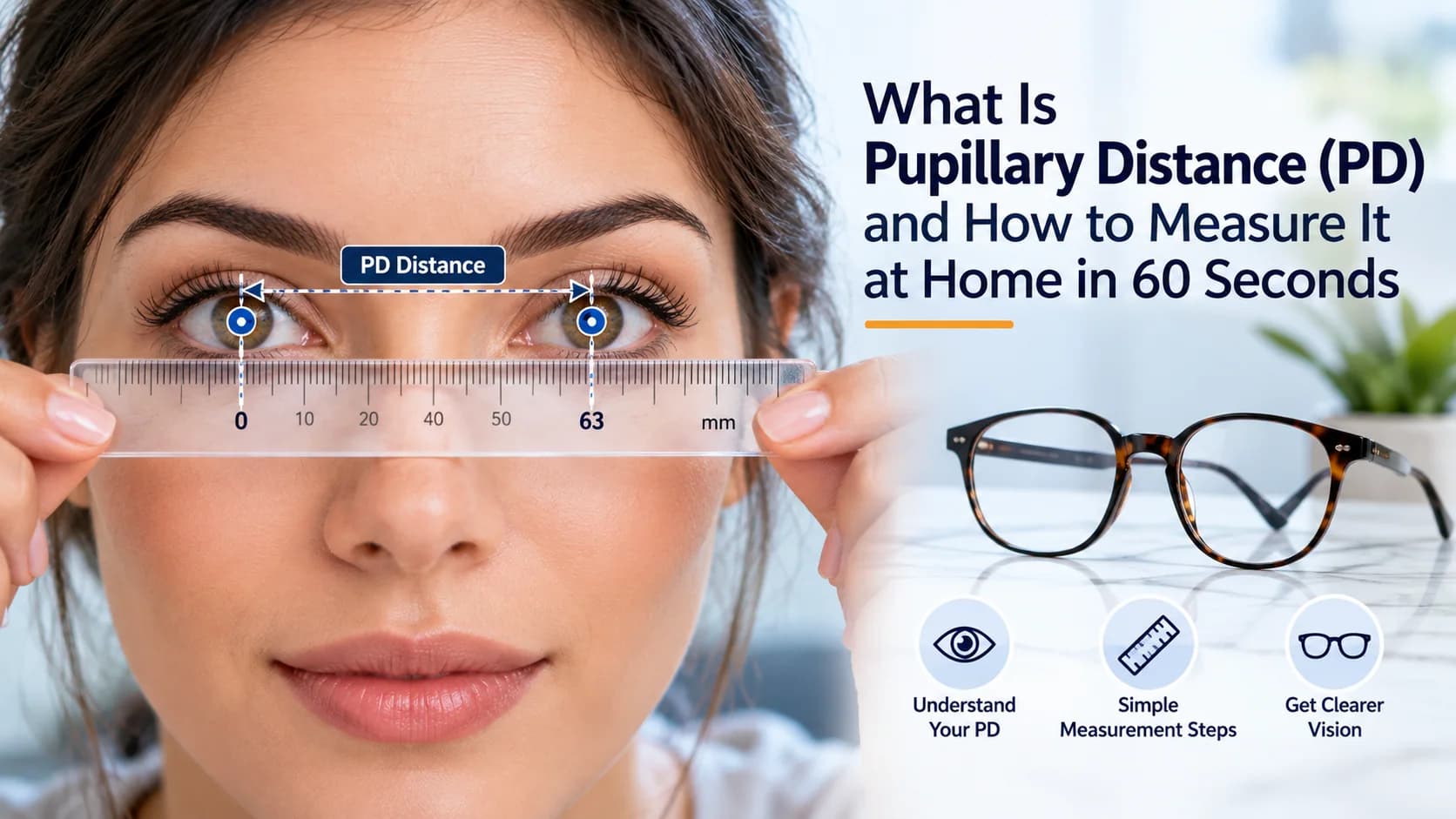
When ordering prescription glasses online, you may be asked for pupillary distance, or PD. It is the distance in millimetres between the centres of your pupils and helps position your lenses in front of your eyes.
A careful home measurement can help with a straightforward order. If the reading is unclear, or you need progressive or other multifocal lenses, ask an optical professional to check the measurements needed for your frame.
Why does PD matter?
Lens positioning affects how comfortably you see through your glasses. An incorrect PD can contribute to blur, discomfort or eyestrain. PD is one part of the fitting process; some lens designs also require separate measurements for each eye and a frame-specific height.
Single PD versus dual PD
| Measurement | Meaning | Example |
|---|---|---|
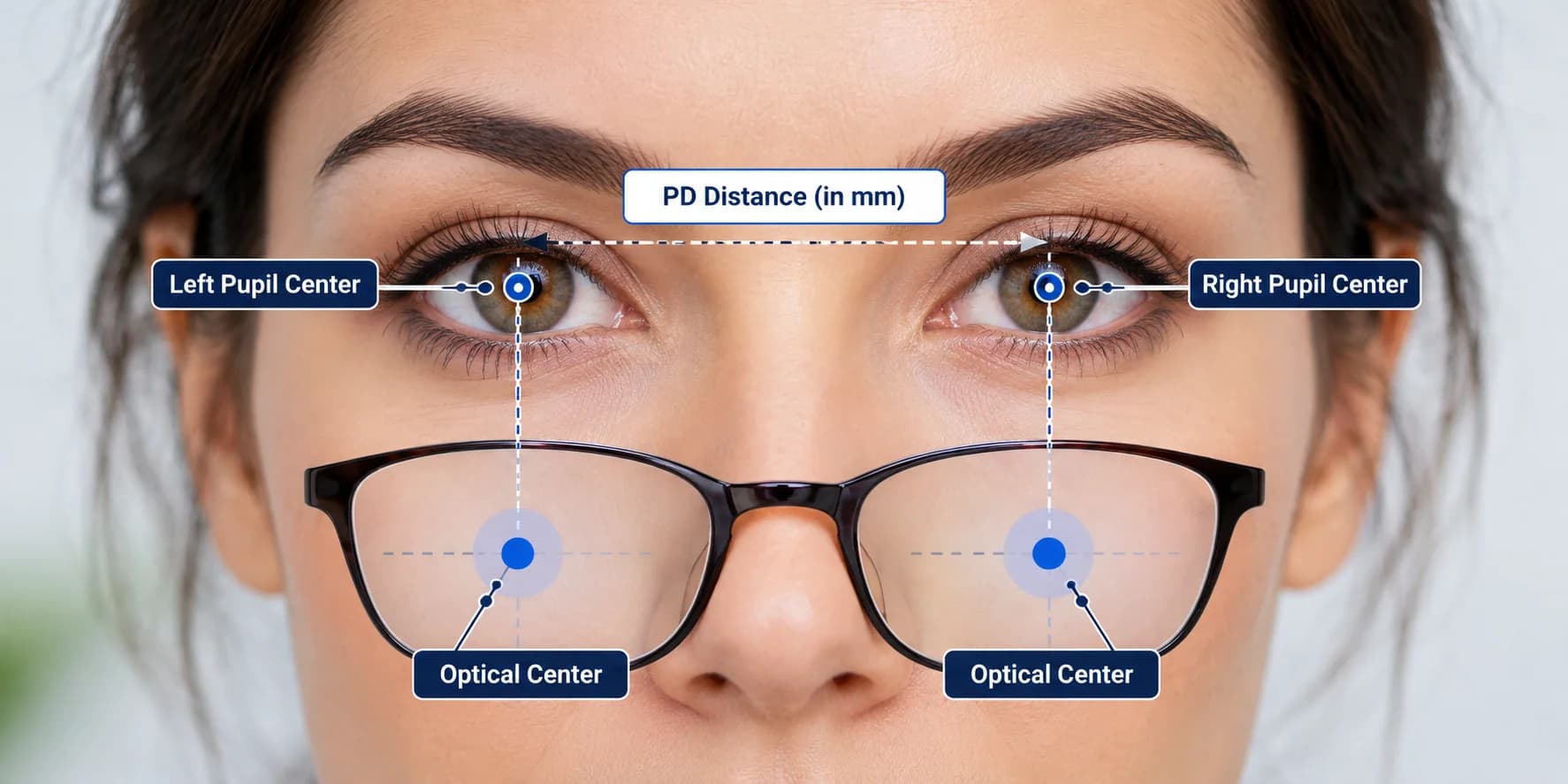
| Single (binocular) PD | The distance between the centres of both pupils | 63 mm |
| Dual (monocular) PD | Separate distances from the centre of the nose to each pupil | 31 mm right / 32 mm left |
A single PD does not prove that the two monocular measurements are equal. If an order asks for separate right and left values, do not simply divide the single number in half.
Why might PD be missing from a prescription?
In the UK, PD is a dispensing measurement rather than part of the spectacle prescription. It is often taken when frames are selected. If you already have a PD, check whether it was measured for distance or near work and whether it is a single or dual reading.
How to measure PD at home with a ruler
- Use a ruler marked in millimetres and stand in good light in front of a mirror.
- Keep the ruler level just above or below your eyes without blocking your view. Look straight ahead at a distant point reflected in the mirror.
- Align the zero mark with the centre of one pupil and read the millimetre mark at the centre of the other pupil.
- Repeat the measurement several times. If the results vary, ask for help rather than guessing.
A second person can help hold the ruler while you look at a distant fixed object past them. Avoid focusing on the helper's nearby face, because your eyes turn inward when looking at close objects.
When should you ask for help?
- Your repeated readings do not agree, or you cannot clearly see the pupil centres.
- You need separate right and left PD values but only have a single PD.
- You are ordering progressive, bifocal or other lenses that need frame-specific fitting measurements.
- Your prescription is strong, includes prism, or previous glasses caused visual discomfort.
What is segment height?
Multifocal lenses need an appropriate vertical position in the chosen frame. Progressive fitting height and lined bifocal segment height are different measurements, each taken for the lens design and how the frame sits on your face. Follow the optical team's instructions for the lenses you order.
Need extra help?
If a measurement or prescription value is missing or unclear, contact Quality Fast Specs before ordering. You can share a clear copy of your current prescription for the team to review.
Frequently asked questions
What is an average adult PD?
Adult PD varies. A common range is roughly the mid-50s to low-70s in millimetres, but an average is not a substitute for measuring your own PD.
Can I use an old PD measurement?
An earlier adult PD may still be useful. Confirm whether it is a distance or near reading and whether it is single or dual, especially if measurements conflict.
Does PD change for reading glasses?
Near work makes the eyes converge, so near PD can differ from distance PD. The amount varies by person; do not apply a fixed subtraction yourself.
Can QFS help with fitting height?
Contact QFS about the lens and frame you have chosen. The team can explain which measurements are required and how to obtain them.